Body-Weight Back Massage: How Movelio Bed Roller Works
Movelio Bed Roller is a non-electric massage and mobilisation system that uses your body weight to create adjustable massage pressure. You lie relaxed, control the movement and choose the intensity. Movelio Companion App adds personal guidance and is included with both Bed Roller and Bed Roller Professional.
Reaching your own back is only part of the challenge of self-massage. You also need a comfortable position, a manageable amount of pressure and a way to move without losing control. Bed Roller brings those choices together. This article explains why the support, roller shape, frame settings and guidance matter as a system.
A shared method for Home and Professional
Both models use the same massage method: body-weight loading, a supported lying position, self-controlled movement, I-Roller and S-Roller, and six frame settings on each side. The difference is the intended setting and construction.
Bed Roller is designed for home use, with a user weight limit of 100 kg and assembly at home. Bed Roller Professional is designed for frequent shared use in workplaces, clinics and gyms, accommodates users up to 130 kg and arrives fully assembled. Its surfaces are designed for disinfection between users.
The choice between them is therefore about how and where the system will be used. Personal guidance in Movelio Companion App is included with both.
How body weight becomes massage pressure
You lie on the mesh and pillow, then use gentle movements of your legs to move the frame and your body over the roller. Your body weight supplies the load; you control the pace.
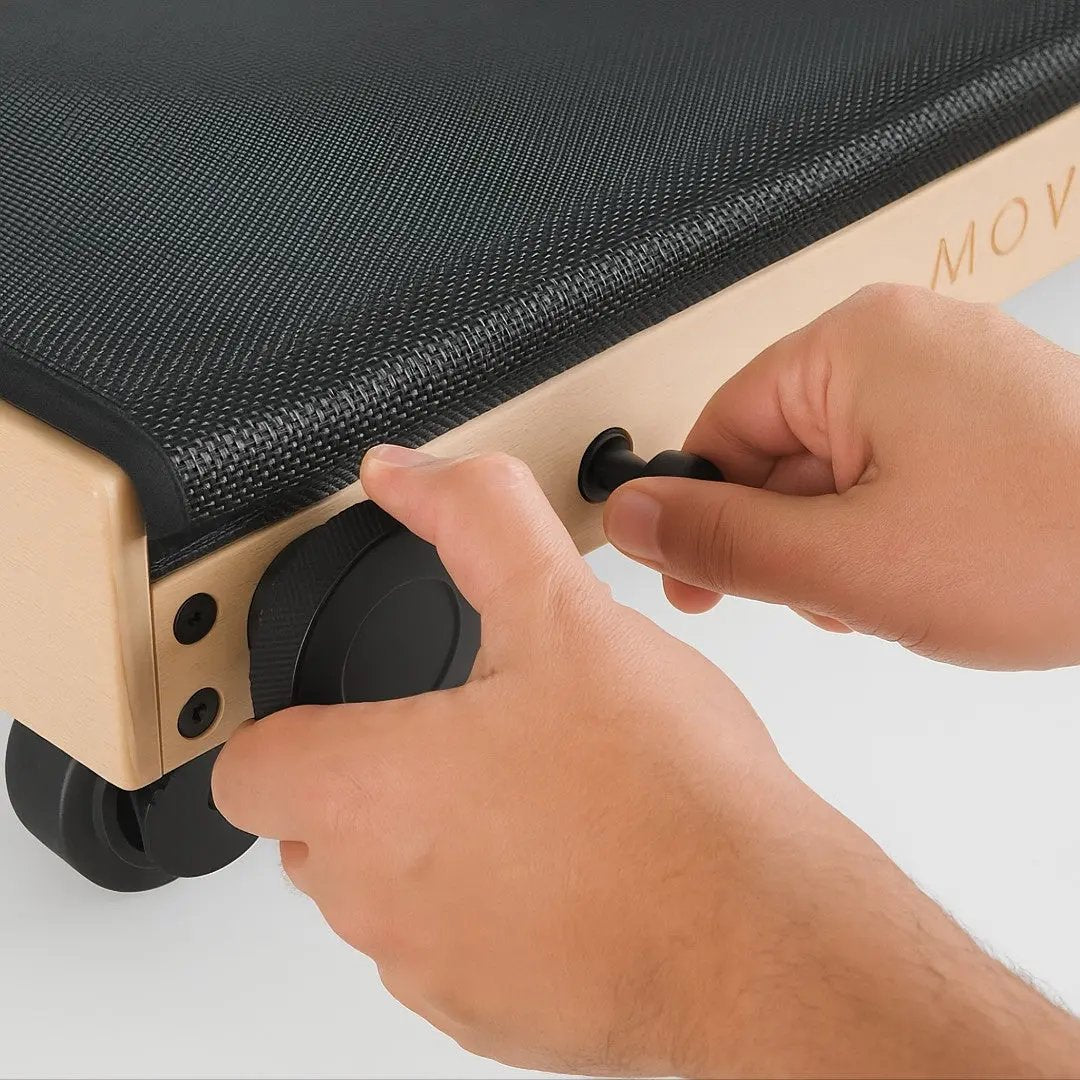
The roller remains on the floor. The frame settings change the height of the wooden frame to which the body-supporting mesh is attached, relative to the roller. Raising the frame reduces pressure against the roller; lowering it increases pressure.
Your weight is shared between the roller and the other points supporting you. Adjusting the frame changes that distribution. It does not lift the roller or alter gravity. Body shape, position and the area being massaged also influence how much load reaches the roller.
This is why a setting is a useful reference rather than a fixed dose for everyone. Two people can choose the same position and experience it differently.

Why a supported position matters
When you want to massage your back, holding a tool behind you or supporting your upper body on your arms can make the task awkward. Bed Roller gives your upper body support while your legs guide the movement.
You can keep your hands free, move slowly and concentrate on how the pressure feels. This makes room for relaxation without requiring every muscle to be inactive. You still need to get into position and control the movement safely.
The practical benefit is the combination of support and control: you can pause, reduce the pressure or change position as needed. Bed Roller grew from Christopher Scheiene's own search for that combination. Read the story behind its development.
36 combinations, with a substantial adjustment range
Six height levels on each side provide 6 × 6 = 36 combinations of height and angle. You can use matching heights or different heights on each side, as shown in the instructions. These are not 36 evenly spaced pressure increments.
In Movelio's practical mechanical test, a 110 kg test person using S-Roller on the lower back produced scale readings of 12.4 kg at the lowest pressure setting and 76 kg at the highest. That is 6.13 times the lowest reading, or approximately a 513% increase in measured load through the roller.
The test used Bed Roller. Both versions have the same pressure-adjustment mechanism. The figures describe this test setup, rather than a result every user will obtain. The test person's weight does not change the Home model's 100 kg user limit.
See the test setup and the measured results.
What does that range give you?
Room to adapt. A new user can begin gently, a sensitive area can receive less load, and different users can choose their own settings. The highest load is an option, not a target.
The scale measured load through the roller. Local pressure also depends on the contact area. A broader roller and a more focused roller can therefore feel different even when they carry the same total load.

I-Roller and S-Roller: choosing the contact
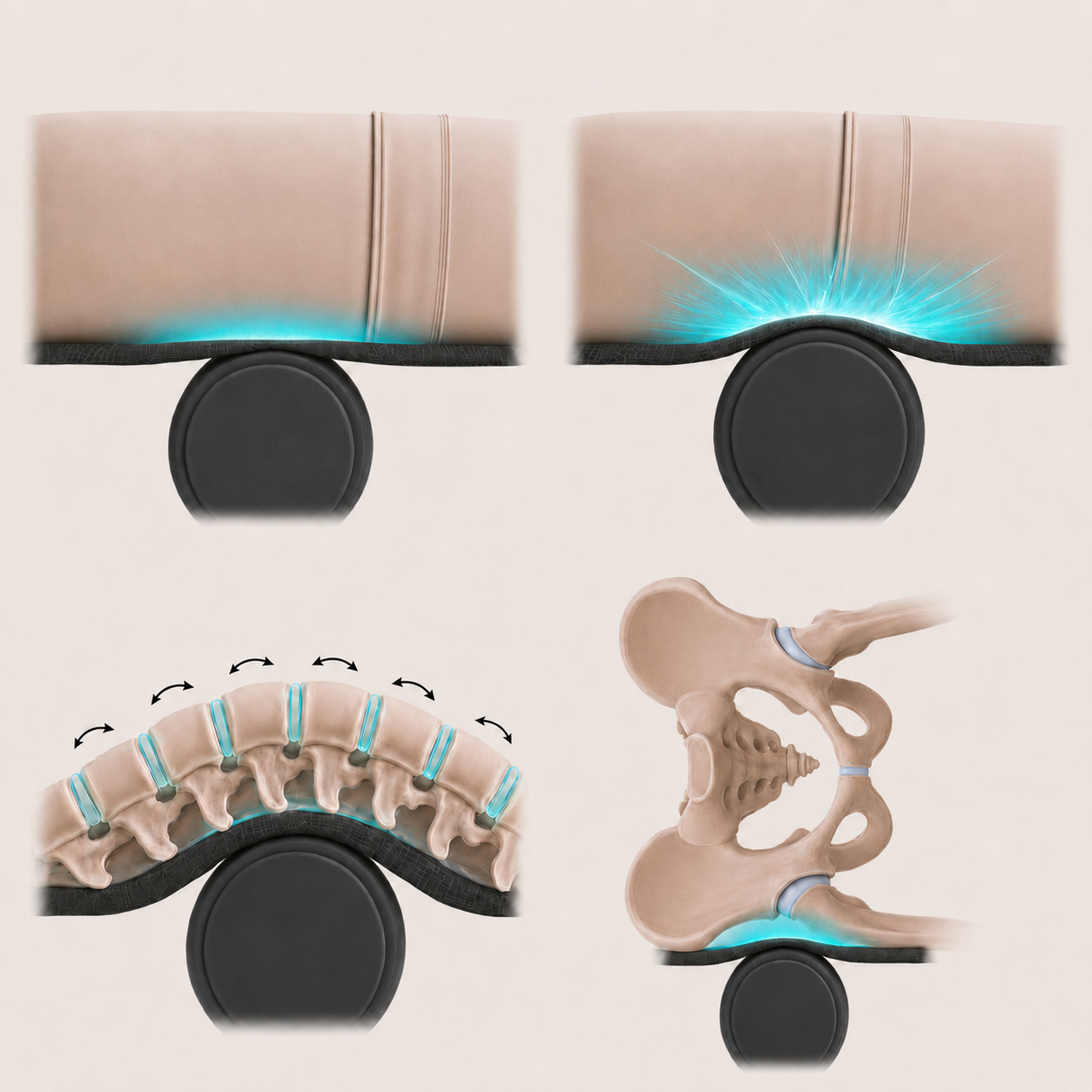
I-Roller provides broader, more even contact. It spreads the load across a larger area. S-Roller provides more focused contact through two raised zones, with a central channel that leaves space for the spine.
Roller choice and frame height work together. S-Roller is not a mandatory next level, and you do not need to progress away from I-Roller. Choose the contact that suits the area and the programme you are following.
The system also supports positions for the glutes, outer hips, and front and outer thighs. You do not need to massage every area in every session. A focused routine can be easier to follow and adjust.

Massage and mobilisation in the same movement
Massage is the pressure and movement against soft tissue. Mobilisation here means the controlled movement of the body as it passes over the roller and its support changes. You decide how quickly to move and how far to go within the recommended positions.
Slow rolling moves the contact along an area. A brief pause keeps it more local. Both can be used as described in the instructions, without a motor setting the pace. Explore static and dynamic massage in more detail.
The important practical distinction is that pressure and movement can be adjusted together. You can reduce the load while finding a comfortable movement, or keep a familiar setting and slow down. This is a description of controlled massage and mobility work, not a promise to correct a spinal condition.
See the method in use. Explore the positions and adjustments on the product page.
Explore Movelio Bed RollerWhat can research explain?
Research on related massage methods helps put the experience in context. It also helps distinguish what a product does mechanically from what a study has demonstrated.
A 2019 meta-analysis of foam rolling reported short-term benefits for flexibility and post-exercise muscle soreness. These findings concern the tools and protocols studied, not clinical testing of Bed Roller.
Why an area may feel less tender
In a study of rolling massage, pressure-pain thresholds increased locally and in the opposite calf. This suggests that nervous-system responses may contribute alongside effects at the contact site.
A feeling of “loosening up” can describe less stiffness, less tenderness or easier movement. It does not establish that a physical knot or fascial adhesion has been broken apart. For your own routine, the useful observation is how comfortable the movement feels during and after use.
Keep the evidence in proportion
Bed Roller's frame, rollers and adjustment range are product features. The load test is a mechanical measurement. Studies of foam rolling provide relevant background. Establishing specific health outcomes for Bed Roller requires research on Bed Roller itself. These different kinds of evidence answer different questions.
Regular use: finding a routine you can maintain
A 2022 review of 11 studies involving 290 healthy participants found that foam-rolling programmes could improve range of motion, with results differing by muscle group and programme duration. It does not establish an optimal Bed Roller schedule.
Regular use means repeating a suitable routine over time. It does not automatically mean daily use. Frequency, session length, roller choice and load together influence how demanding the session is: a short, gentle session is different from a long session with focused pressure.
Follow the instructions and your programme, and consider how you feel afterwards as well as during the session. If tenderness increases, reduce the load or take a break. There is no need to keep increasing intensity to make a routine worthwhile.
Changing one factor at a time makes the response easier to understand. For example, keep your roller and frame setting while finding a comfortable pace before changing another part of the session.
From an adjustable system to personal guidance
Having choices is useful when you know where to begin. Movelio Companion App uses your selected body areas, your ratings of discomfort and previous sessions to provide a personal programme developed with physiotherapist Stian Engum.
The guidance covers areas, roller choice, pressure, duration and frequency. You can record completed sessions and follow your progress over time. The physical adjustments remain in your hands: the app does not move the frame or automatically increase the pressure.
Bed Roller gives you physical control. The app adds structure: a place to start, a session to follow and an opportunity to reassess. See how Movelio Companion App works.
Access is included with both models at no additional cost. Your records help you follow your own experience; they are not a diagnosis or proof of what caused a change.
How does it compare with other massage tools?
A foam roller is compact and uses body position to regulate load, often with floor work and support from the arms and legs. A massage gun offers handheld percussion on areas you can reach; parts of the back may require help or an attachment.
Bed Roller combines a supported lying position, adjustable loading and self-controlled movement. It is particularly relevant when you want to massage your back without holding a device behind you.
Choose around the task, the space available and the way you prefer to move. Features vary between products. Our guide to choosing a massage device compares the alternatives in more detail.
A comfortable starting point
- Read the user manual and safety information before your first session.
- Choose a recommended position and a gentle pressure setting.
- Begin with a short session and slow, controlled movement.
- Follow your programme and adjust according to your response.
Stop with sharp, sudden or increasing pain. Follow the contraindications and weight limit for your model, and seek professional advice for new or persistent symptoms. Massage can be part of your self-care routine alongside everyday activity; it does not replace medical assessment.
Frequently asked questions
Do both models use the same massage method?
Yes. Bed Roller and Bed Roller Professional share the pressure-adjustment principle, rollers and self-controlled movement. Their construction and intended use differ.
Is more pressure always better?
No. Choose a manageable load for the area and your experience. There is no requirement to reach the highest setting.
Does a 513% increase in roller load mean the same increase in tissue pressure?
No. The test measured load through the roller. Contact area and body position also influence local pressure.
Should I use Bed Roller every day?
Daily use is not a universal goal. Follow the manual and your programme, and adjust frequency and duration to your response.
Is Movelio Companion App included?
Yes. Access to personal guidance is included with both Bed Roller and Bed Roller Professional at no additional cost.
The physical system and the guidance, together
Choose Bed Roller for home use or Bed Roller Professional for frequent shared use. Both give you adjustable massage, controlled movement and access to Movelio Companion App.